
Here is the thing about buying a product with 48,000 five-star reviews: you assume the crowd has already stress-tested every failure mode and warned you about the ones that matter. I made that assumption when I picked up the MEATER Plus wireless meat thermometer, and within my first three cooks I ran into two problems that nobody in 48,000 reviews had mentioned clearly enough to register. Neither problem broke the product for me. Both problems would have been nice to know before I started. This review is the one I wish existed when I was standing in my backyard with a raw tri-tip in one hand and a brand-new probe in the other.
The MEATER Plus (ASIN B07H8WTFHW) is a single wireless probe that reads both the internal temperature of your meat and the ambient temperature near the grill surface, with a rated Bluetooth range of 165 feet extended by a bamboo charging dock that acts as a repeater. It runs in the mid-range and it is the best-selling wireless probe thermometer on Amazon. This review is not going to tell you it is perfect. It is going to tell you exactly where it will surprise you, why those surprises are manageable, and who actually gets the most value out of it.
The Quick Verdict
The MEATER Plus earns its reputation on probe accuracy and app quality, but new buyers hit a real learning curve on probe positioning, Bluetooth-only limitations, and the one-probe ceiling. Understand those going in and this thermometer absolutely delivers.
Amazon Check Today's Price →You've already ruined one expensive cut guessing at doneness. The MEATER Plus fixes that problem at the root.
Real-time internal and ambient temperature readings, a finish-time estimator that actually works past the midpoint, and Bluetooth monitoring so you stop hovering over the grill lid. Over 48,000 backyard cooks rate it 4.4 stars. Check today's price on Amazon and see if it's right for your setup.
Amazon Check Today's Price on Amazon →How I've Used It: Three Different Grill Setups, Real-World Conditions
My personal testing ran across a gas grill, a charcoal kettle, and a ceramic kamado-style cooker I borrowed from my neighbor Marcus for a four-weekend stretch. Gas grills are the setup where the MEATER Plus is most underestimated, in my opinion. Every gas grill owner I know still uses the lid thermometer as their primary temperature reference, and that lid dial is measuring air temperature at the top of the cooking chamber, not at the grate where your food actually sits. The MEATER Plus ambient sensor reads temperature at the probe tip, which is sitting right at grate level inside your protein's immediate cooking zone. The difference between those two readings on my gas grill ranged from 30 to 55 degrees Fahrenheit depending on which burner I had lit. That gap changes your entire cooking approach.
On the kamado, I used the probe through a series of pork tenderloin and spatchcocked chicken cooks at temps between 325 and 375 degrees. On the charcoal kettle I ran it through a six-pound bone-in pork butt at 250 degrees ambient over about eight hours. Across those sessions I logged somewhere between 25 and 30 distinct cooks before writing this. The patterns I noticed are consistent enough that I am confident they are not flukes.

What Nobody Tells You: Probe Positioning Is Half the Product
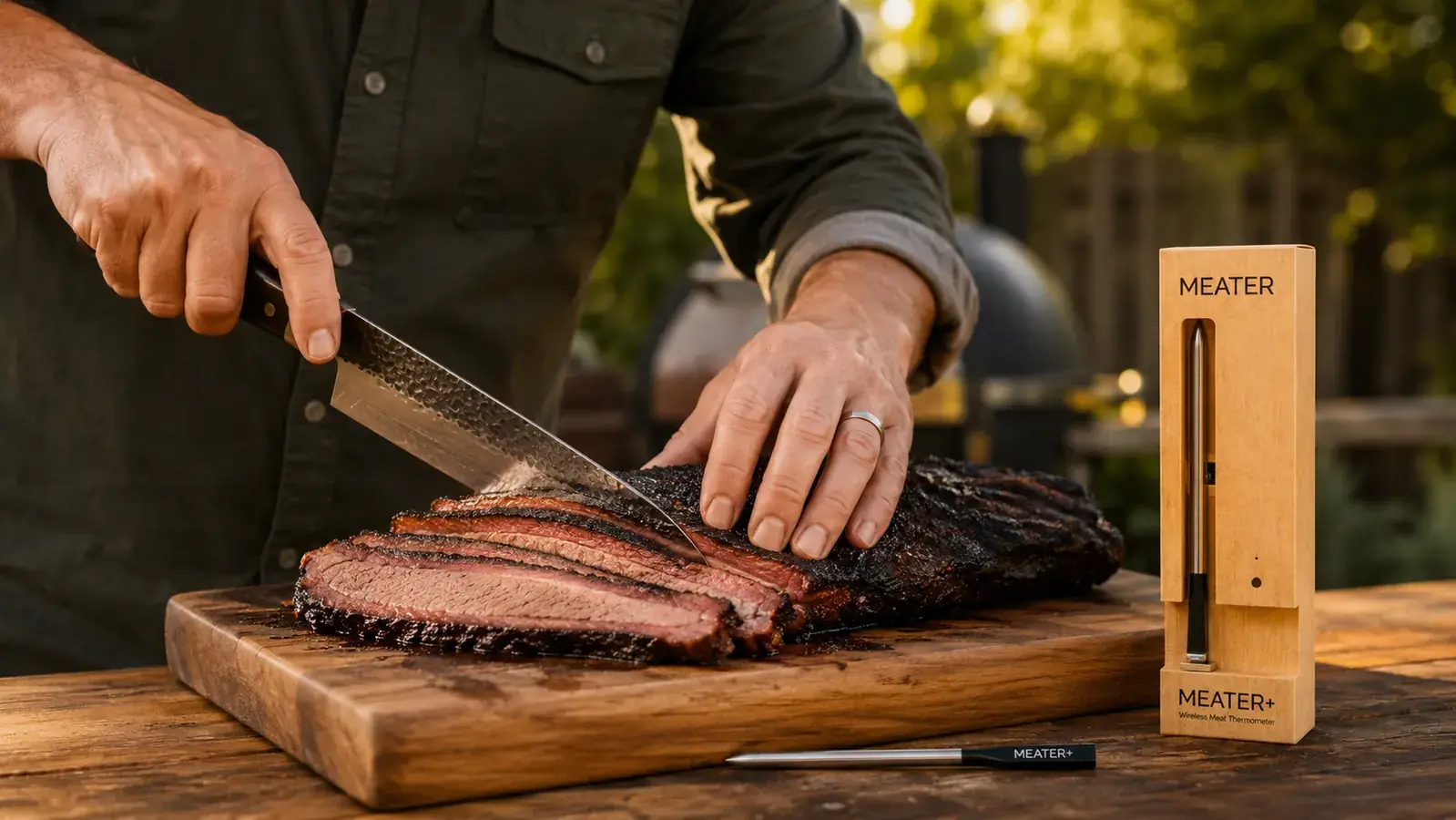
The MEATER Plus probe has a notch on the shaft that marks the boundary between the food-safe silver sensing zone and the heat-proof upper section. The instruction is clear: insert the probe so the entire silver zone is inside the meat, with at least a half-inch of the upper heat-proof section exposed above the surface. I read that instruction. I still inserted it too shallow on my first two cooks because the probe felt seated well before the silver zone was fully buried. The result was an internal temp reading that ran 8 to 12 degrees higher than the actual center temperature, because part of the sensing zone was picking up ambient heat from the grill surface rather than true internal meat temp.
On a pork tenderloin, that kind of variance can take you from perfect 145-degree blush to overcooked 157-degree gray before you realize what happened. The fix is simple: press the probe deeper than feels intuitive until you can see the notch right at the meat surface. Once I started doing that correctly my readings lined up with pull-and-check spot comparisons within one degree. But I wasted two cooks figuring it out, and I have seen enough one-star reviews citing bad accuracy to suspect that shallow insertion is responsible for a significant portion of them. This is not a design flaw in the MEATER Plus. It is a user error that the documentation undersells.
The Hot-Spot Problem: What the Ambient Sensor Actually Reveals
Once I had the probe positioned correctly I started paying attention to the ambient readings in a way I had not before. Here is what surprised me: moving the probe to different positions on my gas grill grate produced ambient readings that varied by as much as 70 degrees Fahrenheit. The center-left zone over my main burner ran dramatically hotter than the far right side where I thought I had been setting up an indirect cook. I had been placing pork shoulders in what I assumed was a 275-degree indirect zone based on the lid dial. The MEATER Plus ambient sensor told me I was actually sitting in a 330-degree zone.
This is not a critique of the MEATER Plus. It is the MEATER Plus doing exactly what it is supposed to do. But nobody in the marketing materials or most reviews prepares you for the disorienting experience of discovering that your mental map of your grill's heat zones has been wrong for years. I had to relearn my gas grill's personality from scratch based on actual ambient data rather than assumptions. That relearning process is valuable. It is also mildly humbling when you have been telling your brother-in-law for a decade that you know this grill.
I spent 15 years convinced I knew exactly where my gas grill ran hot. The MEATER Plus ambient sensor spent about 20 minutes destroying that conviction. My indirect zone was not where I thought it was. Not even close.
The Bluetooth-Only Reality: What the Range Spec Does Not Say
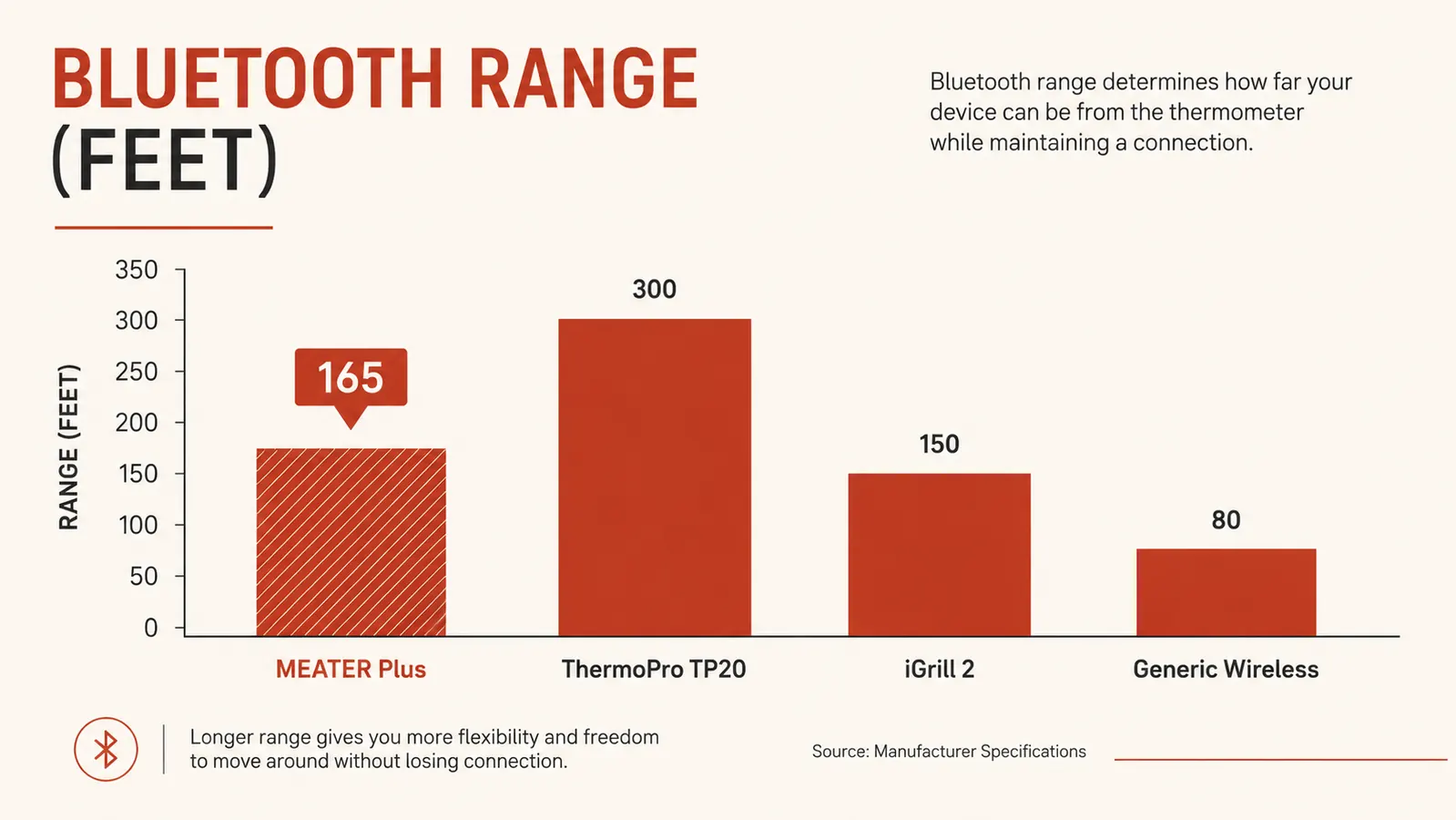
The MEATER Plus advertises 165-foot Bluetooth range. That number is accurate in the sense that I can walk roughly 40 to 50 feet from my grill into my kitchen and maintain signal as long as I keep the bamboo charging dock on the outdoor table within eight feet of the grill. The dock acts as a Bluetooth repeater, so the connection goes probe to dock to phone rather than probe directly to phone. What the spec page does not emphasize: your phone has to stay within Bluetooth range of the dock. If your kitchen is 40 feet away and the dock is outside, you need your phone within Bluetooth range of the dock, not just the probe.
For truly untethered monitoring from inside your house, you need MEATER Cloud, which routes the data over your home WiFi instead of Bluetooth. That subscription is not included with the MEATER Plus hardware. The Cloud feature extends your monitoring range to anywhere you have a phone signal, which is genuinely useful for a 10-hour brisket session. But it is a recurring cost on top of the hardware price, and the marketing on the product listing page is easy to read as implying more mobile freedom than the base Bluetooth-only setup actually delivers. If you want to compare the MEATER Plus against a wired competing option where range is never a variable, take a look at our breakdown of the MEATER Plus vs ThermoPro wireless thermometer.
The One-Probe Problem: What Nobody With a Full Grill Wants to Hear
The MEATER Plus comes with one probe. One probe monitors one piece of meat. This is obvious from the product listing but somehow doesn't register as a real limitation until you are standing over a grill with a full rack of baby back ribs, four bone-in chicken thighs, and a tri-tip roast all cooking at once and you have to choose which one gets the scientific treatment while the other two get your intuition.
At a Fourth of July cookout last summer I had that exact situation. I put the MEATER Plus in the tri-tip because I cared most about hitting 130 internal on that cut. The ribs I pulled by feel and the bend test. The chicken I spot-checked with an instant-read. The tri-tip came out perfect. One of the chicken thighs was 158 internal at the breast attachment when I plated it, which is fine, but I would have preferred to nail it at 165. The honest truth is that the single-probe MEATER Plus is designed for the cook that centers on one primary protein. If your typical backyard session involves multiple proteins at different target temperatures running simultaneously, you will feel the one-probe ceiling and either accept it or eventually buy a second probe or upgrade to the MEATER Block.
Is It Waterproof? The Question Everyone Asks After the First Cook
The answer is: the probe is water-resistant and splash-proof but not submersion-rated. You can rinse it under running water, wipe it clean after a cook, and not worry about rain landing on it while it is in the grill. What you should not do is drop it in a bucket of water or run it through the dishwasher. The ceramic tip at the end of the probe is the fragile point. MEATER is clear in their documentation that the probe is not dishwasher-safe and that the ceramic tip can crack if thermally shocked by going from a very hot cook directly into cold water. Rinse it under warm water after it has cooled. That is all the maintenance it needs.
The bamboo dock does not tolerate outdoor humidity well over extended periods. I keep mine inside between sessions rather than leaving it on the patio table, and the wood has stayed clean and functional. Leave it outside in summer humidity and you will see surface weathering and potential splitting over time. This is not a defect so much as a natural material limitation. A small detail worth knowing before your first season.
Android vs iOS: The App Parity Gap Is Real
The MEATER app on iOS is smooth, stable, and feature-complete. The Android version, based on what I have seen from friends who run Samsung and Google Pixel devices, lags behind in occasional stability and feature rollout timing. I run iOS so this is second-hand observation, but it is consistent enough across multiple Android-using friends that it is worth flagging. Android users in recent reviews have reported that certain guided cook features and UI refinements that have been on iOS for months arrive on Android later or with slightly different behavior. MEATER has been improving Android parity over time, but if you are on Android and highly particular about app software quality, read the most current Android reviews before buying rather than relying on the iOS-driven aggregate rating.
For a deeper look at how the MEATER Plus compares against the long list of reasons any wireless thermometer changes how you think about grilling, the article on 10 reasons a wireless meat thermometer changes your grill covers the broader case for making the switch from guessing to measuring.
What the MEATER Plus Actually Gets Right
I have spent a lot of this review on the things nobody warns you about, so let me be equally direct about what works. The probe accuracy is as good as advertised. I cross-referenced it against a calibrated instant-read thermometer on a pork butt at 170 degrees internal and got a one-degree difference. At 203 degrees internal I got a half-degree difference. For a probe that lives in smoke and grease, that consistency is remarkable. The app's guided cook feature genuinely simplifies cuts that have precise pull-temperature windows, like poultry where the margin between underdone and dried-out is about 10 degrees. And the finish-time estimator, once a long cook clears the stall and the internal temp starts climbing steadily again, is accurate enough to base your side-dish prep timing on.
The wire-free design matters in practical ways that are hard to fully appreciate until you have used a wired probe and experienced the lid-seal gap issue. Every wired probe trailing out from a closed grill lid creates a small gap in the seal. On a low-and-slow cook where you are working hard to maintain a steady 250 degrees, that gap costs you temperature stability and forces you to use more fuel to compensate. The MEATER Plus probe sits entirely inside the cooking environment with no wires crossing the lid seal. That alone is worth something to any serious low-and-slow cook.
What I Liked
- Probe accuracy is exceptional, within one degree Fahrenheit of a calibrated instant-read across repeated spot checks
- Wire-free design eliminates the lid-seal gap that undermines temperature consistency on long low-and-slow cooks
- Ambient sensor exposes real grill hot spots that your lid thermometer has been misrepresenting for years
- App finish-time estimator is reliable enough to base your side-dish timing on once the cook clears the stall
- Water-resistant probe cleans up easily with a warm-water rinse after each cook
- Guided cook presets simplify less-familiar cuts with precise pull-temperature windows like poultry and pork tenderloin
Where It Falls Short
- Probe insertion depth matters more than the documentation emphasizes, and too-shallow placement causes inaccurate readings that get blamed on the product
- Bluetooth-only base setup requires your phone to stay within Bluetooth range of the dock; truly untethered monitoring requires a paid MEATER Cloud subscription
- Single probe means you monitor one protein per cook, which feels like a real ceiling on a full grill with multiple proteins running simultaneously
- Bamboo dock weathers in outdoor humidity and is better stored inside between sessions rather than left on the patio table
- Android app lags behind iOS in feature parity and occasional stability, making the aggregate star rating less applicable to Android users
Who This Is For
The MEATER Plus is the right product for the backyard cook who centers their sessions around one primary protein, especially large cuts like pork butt, whole chicken, tri-tip, or a beef roast where hitting a specific internal temperature is the difference between a meal worth talking about and one worth forgetting. It is particularly well-suited to gas grill owners who have been flying blind on grill-surface temperature because their lid dial reads the top of the chamber rather than the actual cooking zone. The ambient sensor on a gas grill is revelatory in a way that charcoal or kamado cooks, who tend to be more temperature-obsessed already, may find less surprising.
Who Should Skip It
If your grill setup involves four or more proteins at different target temperatures on a regular basis, the single probe will frustrate you quickly. Budget for a second MEATER Plus probe or consider the MEATER Block from the start. If you are an Android-first household that relies heavily on app features and wants parity with iOS, wait for a few more app update cycles or read the most current Android-specific reviews before committing. And if your definition of a cookout is fast-and-hot burgers and hot dogs where every protein hits the plate in under 15 minutes, a premium wireless probe is solving a problem you do not actually have.
Know the limitations going in and the MEATER Plus is exactly as good as 48,000 people say it is.
Nail the probe insertion depth, keep the dock close to the grill, accept the one-probe reality, and this thermometer will deliver accurate real-time temp data and finish-time estimates that change how you manage every cook. Check today's price and see current availability on Amazon.
Amazon Check Today's Price on Amazon →