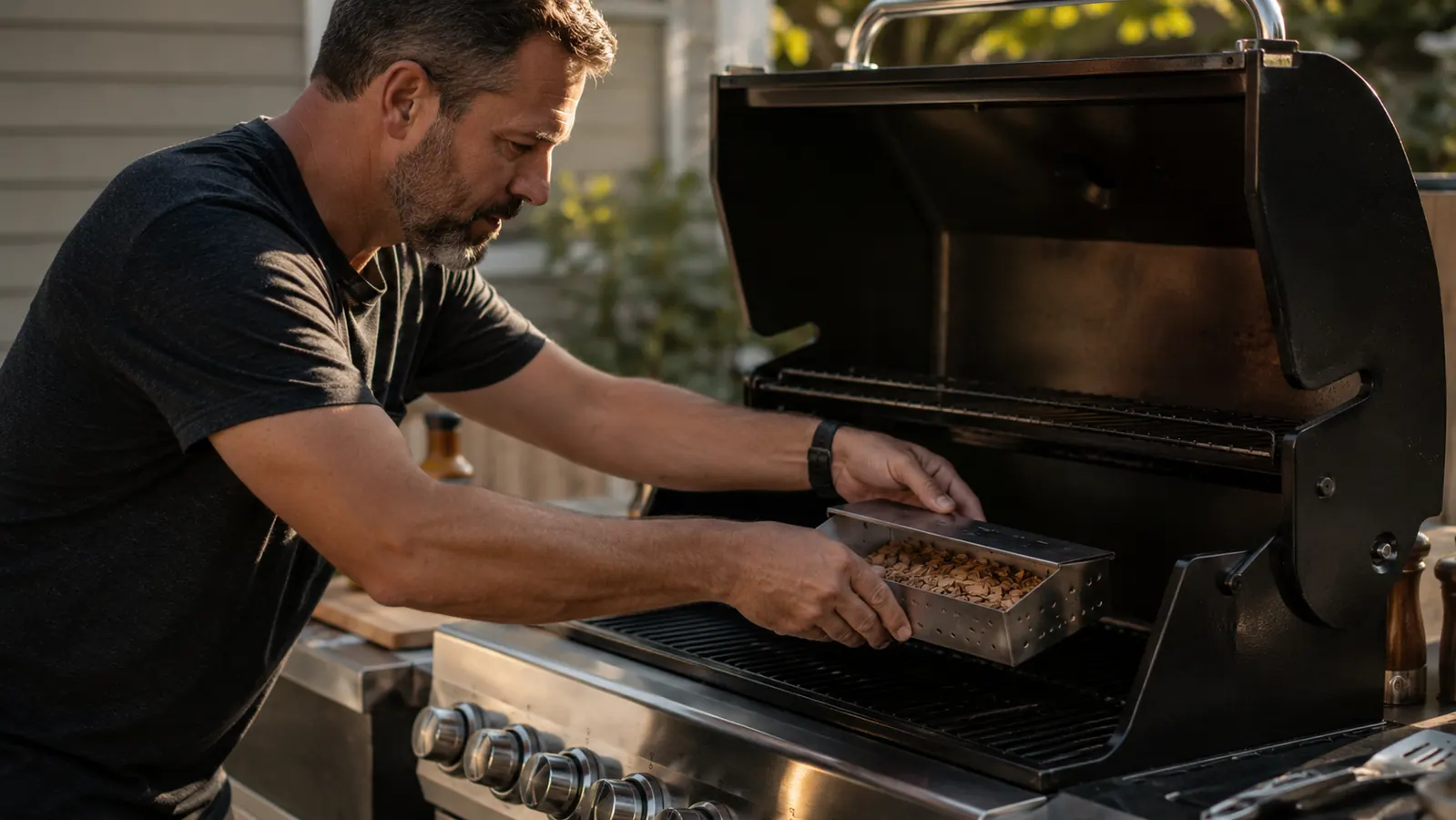
I spent the first three years of owning a gas grill convinced I was doing something wrong. Every time I cooked ribs or a pork shoulder, the meat tasted fine but that deep, slow-campfire smokiness was just missing. My neighbor Bobby would lean over the fence and say, 'Gas grill, huh?' with that look. You know the look. What I didn't know then was that the gap between 'gas grill food' and 'real BBQ flavor' is about the size of a stainless steel box the length of your forearm. A smoker box. Once I figured out how to use one correctly, that look from Bobby changed.
The problem most beginners run into is not the smoker box itself. It's the sequence. They dump in chips, drop the box anywhere, light the grill, and wonder why the smoke either never starts, burns out in ten minutes, or tastes bitter and harsh. There is a right way to do this, and it only takes learning once. I'll walk you through exactly how I do it using the Weber Premium Stainless Steel Smoker Box, which I've been running on my Spirit II grill since 2022. Same five steps every cook. Works every time.
Stop guessing at smoke flavor. The Weber Smoker Box makes it repeatable.
The Weber Premium Stainless Steel Smoker Box fits any gas grill, fills in seconds, and holds enough chips for a full smoke session. Rated 4.6 stars by more than 3,800 backyard cooks.
Amazon Check Today's Price on Amazon →Step 1: Choose Your Wood Chips and Decide Whether to Soak Them
Before you touch the grill, you need to settle the soaking debate, because it's the first thing every beginner trips over. You've probably read somewhere that soaking wood chips in water for 30 minutes makes them last longer. I soaked chips for years. Then I stopped, and here's what I noticed: soaked chips delay the smoke by eight to ten minutes while the water steams off, and that early steam can make the smoke taste thin and slightly acrid. Dry chips hit their smoke point faster, burn cleaner at high grill temps, and produce a denser, sweeter smoke flavor. My recommendation for gas grill smoker box use is to go dry, every time.
For wood species, stick to what matches your protein. Hickory and oak are the all-purpose choices that work on everything from chicken thighs to pork ribs to burgers. Apple and cherry wood give a milder, slightly sweet smoke that pairs beautifully with chicken, pork tenderloin, and fish. Mesquite burns hot and intense, which is great for a quick sear on beef steaks but can overpower anything that cooks for more than 30 minutes. When I'm doing ribs or a butterflied leg of lamb, I reach for hickory. When I'm doing a spatchcocked chicken for my wife Linda, I use apple chips. Start with one species at a time so you can dial in what you like before you start blending.
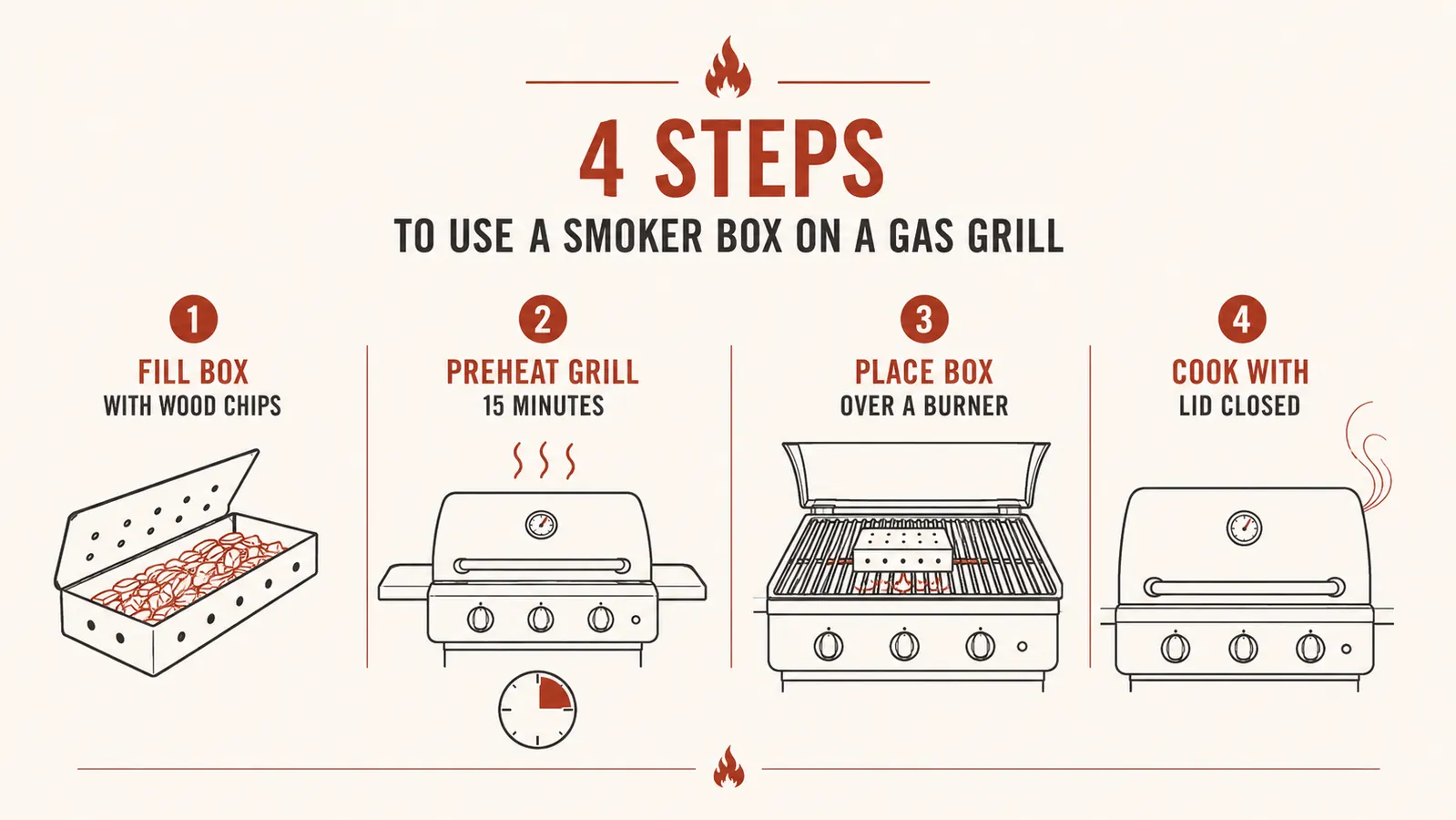
Fill the Weber Smoker Box about two-thirds full. That's roughly a large handful of chips, or about half a cup. You want airflow through the box so the chips can smolder rather than just bake and die. Overfilling chokes out the smoke. Underfilling gets you 15 minutes of smoke and then nothing for the rest of the cook. Two-thirds full is the sweet spot that I've settled on after a lot of trial and error.
Step 2: Fill the Smoker Box and Place It Over a Burner
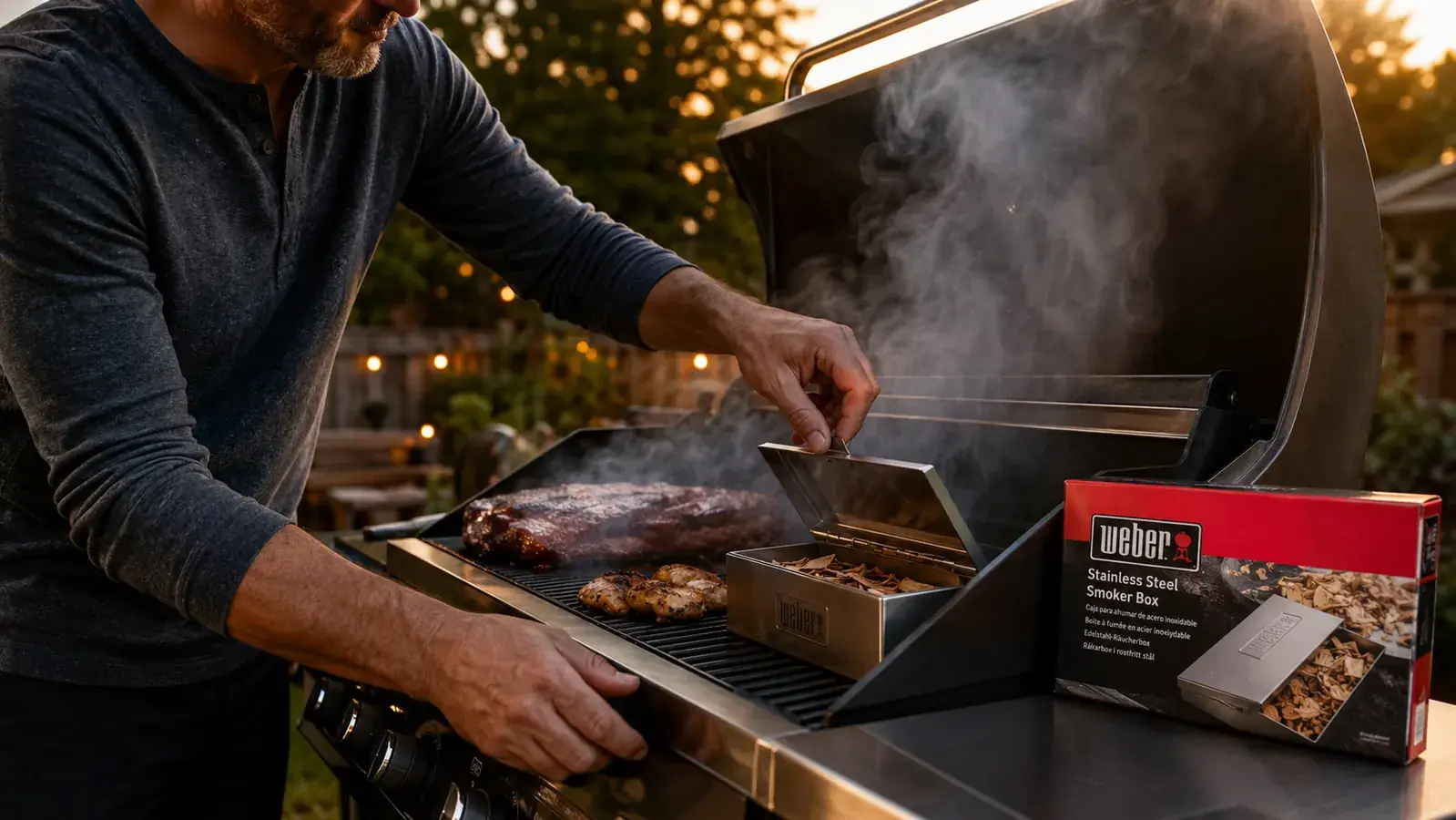
The Weber Smoker Box has a hinged lid that flips up for easy filling, which sounds like a minor thing until you've tried to funnel chips into a sealed container with oven mitts on. Lift the lid, pour in your dry chips, close it. Take 30 seconds. The lid itself has small vents that control oxygen flow and let smoke escape, and the stainless construction means it handles the direct heat without warping, which is something I cannot say about the cheap generic box I used before.
Once filled, place the smoker box directly on the grill grates, positioned directly over one of the burners. Not between burners. Not on the far side of the grill. Directly over a burner. The box needs a concentrated heat source underneath it to get the chips hot enough to smolder and produce smoke. On my Spirit II, I put it on the left burner, all the way to the back corner so it stays out of the way of the meat. The box is compact enough that it doesn't eat up much cooking space.
One thing beginners get wrong here: they put the box on the grate and then put meat right on top of it. Don't do that. The box needs unobstructed airflow and it needs to be hot. Keep a couple inches of clearance around it. Think of it as a dedicated smoke station, not a shelf.
Step 3: Preheat the Grill Until You See Steady Smoke
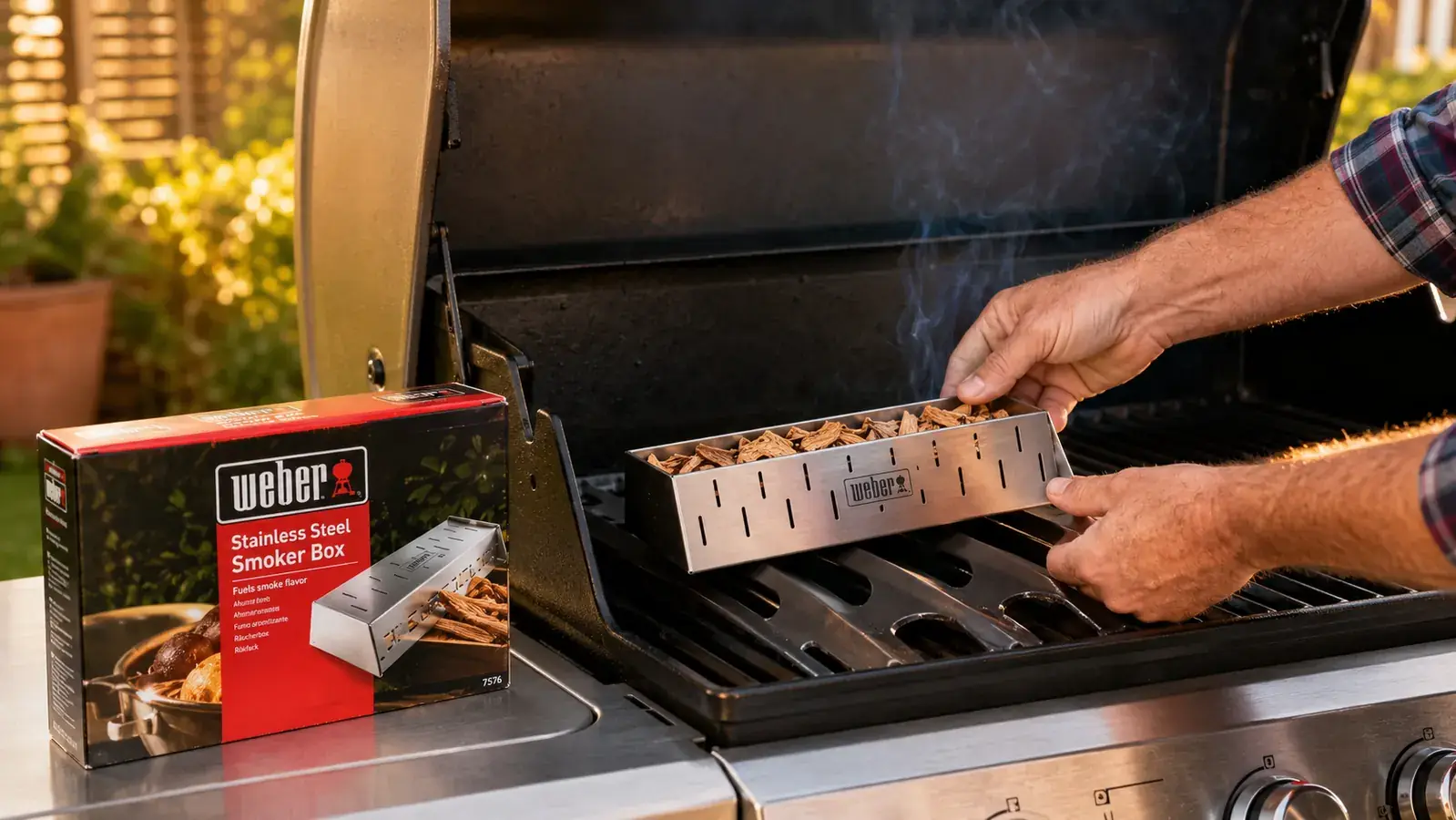
This is the step most beginners skip, and it's the reason their smoke flavor is weak. Close the grill lid and light the burner under the smoker box on high. Let it run for 10 to 15 minutes before you put any food on. What you're waiting for is steady smoke coming out of the smoker box vents, not steam, not nothing, but a consistent thin blue-white smoke. That's the sign the chips have hit their smolder temperature, which is around 570 to 750 degrees Fahrenheit at the chip surface.
You might see white steam or nothing for the first five minutes. That's normal. At around the 10-minute mark, you should start to see a shift: the smoke gets thinner, bluer, and more consistent. If you're at 15 minutes and still just seeing steam, your burner under the box may not be running hot enough. Crank it up a notch. Once you see steady smoke, the grill is ready to cook. I usually use this wait time to prep my rub or sauce and get the meat out of the fridge to take the chill off.
Step 4: Set Up a Two-Zone Fire for Better Smoke Penetration
Here's something that took me two full grilling seasons to figure out, and I want to save you that time. If you run all the burners on high and put the meat over direct flame, two things happen: the outside of the food sears fast, which seals the surface before much smoke can penetrate, and the cook is over before the smoke box gets a chance to do its job. The fix is a two-zone setup.
Leave the burner under the smoker box on high. Set the other burner or burners to medium-low. Place your food on the cooler side, over the unlit or low-heat zone. Close the lid. The heat and smoke circulate together, which means the smoke wraps around the food slowly rather than just kissing the outside. For chicken pieces this setup is all you need. For ribs and pork shoulder, you can also wrap the food in foil with a splash of apple juice for the last hour to lock in moisture. The two-zone method is how backyard cooks replicate what a real offset smoker does.
Keep the grill lid closed as much as possible during the cook. Every time you open it, you let out heat and smoke. The smoke needs to accumulate inside the grill hood to do its work. I tell people: open the lid only when you have a reason to. Flipping the meat and checking internal temp count as reasons. Curiosity does not.
The smoke needs to accumulate inside the grill hood to do its work. Open the lid only when you have a reason to. Curiosity does not count.

Step 5: Maintain Your Smoke Throughout the Cook
A full load of wood chips in the Weber Smoker Box will typically produce smoke for 45 to 60 minutes, depending on how hot you're running that burner and what type of wood you're using. Denser woods like hickory and oak tend to last longer than fruitwoods. For a quick 20-minute chicken cook, one fill is more than enough. For a low-and-slow pork shoulder that takes three to four hours, you'll want to reload the box once or twice.
Reloading is simple because of the Weber's hinged lid design. Use a long pair of tongs to pull the box slightly toward you, flip the lid, add another handful of chips, close it, and slide it back. Takes less than a minute. The box will be hot, so use protection. I keep a pair of silicone-grip tongs dedicated to moving the smoker box so I'm not fumbling around with the cooking tongs.
A note on timing: the first 30 to 45 minutes of smoke is when food absorbs smoke most readily, when the surface is still moist and the proteins are still open. After that the exterior starts to firm up and set, and smoke penetration slows down significantly. So if you only have one load of chips and the cook runs long, front-load your smoke. Start the box before the food goes on, let it run hard for that first half hour, and if you can only refill once, do it around the 40-minute mark.
After the cook, let the smoker box cool completely on the grill before handling. Once it's cold, shake out the ash, rinse it under hot water, and dry it. The stainless steel cleans up easily and does not need soap unless there's grease splatter. I've had mine for three-plus years and it still looks and performs like it did on the first cook.
What Else Helps You Get More Smoke Flavor on a Gas Grill
The smoker box does the heavy lifting, but a few supporting habits push your results further. First, use a leave-in wireless meat thermometer so you're not lifting the lid to check doneness. I've been using a wireless thermometer for over two years and it cut my lid-opening habit by probably 70 percent. Every open lid is a few degrees of heat loss and a small puff of smoke escaping into the yard instead of onto your ribs. Fewer lid lifts equals more smoke time. You can read more about the thermometer I trust in my full review over at the Weber Smoker Box review article where I walk through how I pair these two tools.
Second, consider your grill grate material. Cast iron grates hold heat better than stainless and create better sear marks, but more importantly they stay hotter during lid opens so your smoke recovery time is shorter. If you're serious about backyard BBQ on a gas grill, cast iron grate inserts are worth the investment. Third, don't skip a good dry rub. Smoke adheres to the surface of the meat better when there's a slightly tacky exterior. A dry rub applied at least an hour before the cook, or even overnight, creates that sticky surface. Salt pulls out a little moisture that then mixes with the rub to form a paste that smoke binds to.
If you want to compare the smoker box approach to an alternative method, I put together a head-to-head breakdown in the Weber Smoker Box vs LIZZQ Pellet Tube comparison. Both work well. They just work differently, and which one fits your setup depends on how much smoke output you want and how often you want to reload.
Ready to get real smoke flavor out of your gas grill this weekend?
The Weber Premium Stainless Steel Smoker Box fills fast, fits on any grill, and lasts for years. It's the simplest upgrade you can make to your backyard BBQ game. Over 3,800 reviewers give it 4.6 stars.
Amazon Check Today's Price on Amazon →